
Falling with Confidence: Mastering Ukemi and Essential Self-Defense Tools
One of the most valuable skills you can develop in self-defense or martial arts training is learning how to fall safely. Known as Ukemi in Japanese arts, this isn’t just about hitting the ground—it’s about “receiving the ground” intelligently so you can protect yourself and quickly recover.
What Is Ukemi?
Ukemi is the body’s mostly natural deceleration when falling. Under stress, your automatic protection mechanisms kick in: your arms extend to shield your head, and your body instinctively tries to distribute impact. This differs from a formal breakfall (which we’ll cover in future posts), as Ukemi focuses more on instinctive, practical recovery rather than stylized techniques.
Key Elements of Effective Ukemi
- Hand Placement: Form your hands into an “arrow” shape pointing in the direction you intend to roll. This aligns with the body’s natural spinal response—hands splay forward when falling. To enhance protection, turn your head so your ear faces the ground and forcefully exhale on impact to prevent getting the wind knocked out of you.
- Finger Position: On landing, fingers should point away from the body in that arrow formation.
- Recovery: After the fall, keep your hands up to protect your head while scanning your environment for threats. Always maintain situational awareness.
Rolling Rules (Never Break These)
- Never roll across or over your neck.
- Your head should never touch the ground during the roll.
- Pressure should travel diagonally across the back—from one shoulder to the opposite hip.
Practice Drill: The “Confidence Roll” (Into the Void) Alternate rolling to both sides while moving across the entire mat. Focus on smoothness, keeping the head protected, and building trust in your body’s ability to handle falls.
The 5 Ranges of Self-Defense
Understanding distance is critical in any confrontation. The five ranges are:
- Psychological – Mindset, awareness, and de-escalation
- Kicking
- Punching
- Infighting (close-range strikes and elbows)
- Grappling
Today we’ll focus on tools that shine in the infighting and grappling ranges.
I.G.T. – Impact, Grab & Twist
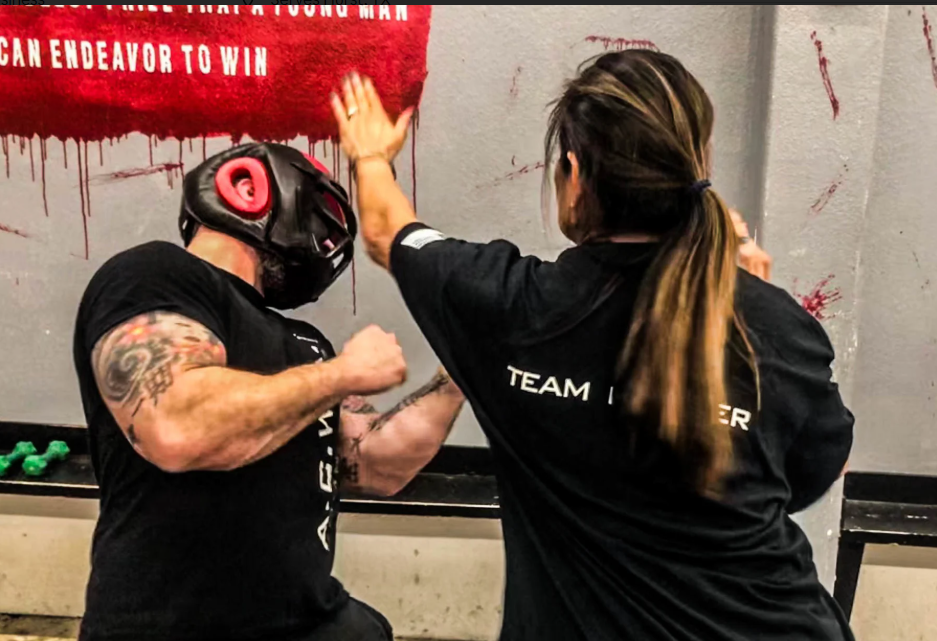
Hands weren’t made for punching—they were made for gripping. The Impact, Grab & Twist (IGT) technique opens up a powerful new dimension of self-defense. When executed properly, it can create immediate space, shut down aggression, or completely change the dynamic of a conflict on both physical and psychological levels.
Why IGT Works So Well
Most people instinctively use a “monkey grip” (grabbing with the thumb on top), but this is weak and easily countered. Instead:
- Impact first with the palm heel to shock and disorient the target (don’t push them away—keep control).
- Grab sequentially starting with the pinky finger, curling each finger in to create a deep, secure grip that pulls the target into your hand.
Physical Reactions to IGT
People react very differently to being grabbed than to being punched. A solid punch to the chest often just makes someone angry and aggressive. A violent grab, however, usually causes the person to tighten up and pull away from the pain. Their hands instinctively move toward the source of discomfort. This creates opportunities to:
- Stop an attack mid-motion
- Draw their hands away from protected targets
- Induce fear and hesitation
- Shift their focus from offense to self-preservation
Most people are simply not accustomed to being grabbed hard and unexpectedly. That moment of confusion is exactly what you want.
High-Value IGT Targets
These areas produce the strongest reactions:
- Inner thighs (extremely vulnerable)
- Groin area
- Pocket between pectoral muscle and armpit
- Cheeks (just above the jaw)
- Nose
- Ears
- Love handles (excess skin on sides of belly)
- Under the triceps
- Back of the knee (knee pit)
- Skin between shoulders and neck (traps)
- Top of the forearm
- Top of the bicep
Practical IGT Drills
Drill 1: Rear IGT Drive Enter with a spearing elbow, spin so your back is to the opponent while maintaining cover (to prevent chokes). Grab their inner thigh with IGT and drive them backward using your elbow as a lever against their hip. Push with your butt/hips. Excellent for multiple-attacker scenarios—drive one back while facing the second.
Drill 2: Check/Hit IGT + Ascending Elbow & Hammer Grab the face with both hands, use their natural retraction to pull them in, then drive an ascending elbow to the jaw followed by a hammerfist to the face.
Advanced Control Tools
The “C” Grip Form a “C” shape with your thumb and middle finger and sink it into the sides of the throat (the indentations beside the larynx). This restricts breathing and is highly effective for takedowns and control. Always provide a surface behind the opponent (wall, ground, your body) for maximum effect.
Philtrum Hook The philtrum—the small groove of skin between the nose and upper lip—is packed with nerve endings. Pressure at a 45-degree angle upward can control even the largest opponent’s head. Quick Demo Drill: Use just one finger on the philtrum to hold someone back as they approach.
Jugular Notch The notch at the base of the front of the neck. Hook your fingers in and apply pressure with a pulling/backward motion. Effectiveness varies by individual.
Rake Techniques (Create Space & Pain)
Rakes use the trailing edge of the fingers (use tips, not pads) to scrape or scratch, disrupting the opponent’s thought process and creating openings.
- Vertical Face Rake: Chin in your palm, fingers hooked over the face. Strike upward into the chin while raking forward, then immediately snap the head back and pull the face downward.
- Horizontal Face Rake: Palm-heel one side of the nose while striking/raking the opposite side of the head. The hands pass in a shearing motion—like pushing their face through a cheese grater.
- Indexed Face Rake: Claw both hands and thrust them into the face one after another, targeting the eyes. This often causes an immediate primal shutdown as people cover their face.
Important: Keep your elbows up in “spear” position throughout to protect your own face.
Applied Drills
- Head Catch → Face transition to Elbow Hammer
- Head Catch → C Grip → Standing Side Base escort movement
Final Thoughts
Ukemi gives you the confidence to move explosively without fear of falling. Combined with IGT, C-Grips, philtrum control, and rakes, you develop tools that work in the chaotic, close-range reality of real violence—where grabbing and controlling often matters more than flashy strikes.
Train these progressively, with a good partner, and always emphasize control before power. These techniques are as much about mindset and awareness as they are about physical execution.
Stay safe, train hard, and remember: the ground is not your enemy—learn to receive it gracefully.