
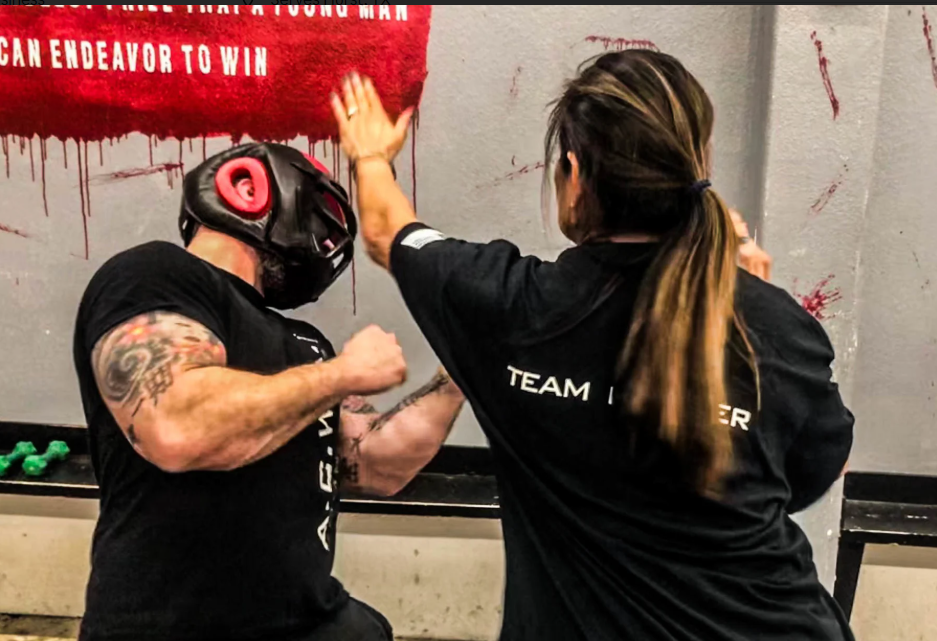
Today’s Lesson: Falling Safely (Ukemi) + The O’Neill Cover & Force Management
Welcome to today’s training! In this session we focused on two critical areas: how to fall safely (Ukemi) and smart decision-making under pressure using the Force Continuum and Cooper’s Color Code. We also drilled practical applications of the O’Neill Cover for close-range protection and countering.
1. Ukemi – “Receiving the Ground”
Ukemi, often translated as “receiving the ground,” is the body’s mostly natural way of decelerating and protecting itself when falling. Under stress, your arms instinctively shoot out to shield your head from impact.
Important note: This is different from a formal breakfall (which we’ll cover in a future lesson). Today we worked on building confidence with natural, protective falling mechanics.
Key Points for Proper Ukemi:
- Hand Placement: Form your hands into an “arrow” shape pointing in the direction you want to roll. This follows the body’s natural spinal reflex — your hands splay forward automatically when falling.
- Head Turn: Turn your head so your ear faces the ground. This protects your face and skull.
- Breathing: Deliver a strong, forceful exhalation on impact to prevent getting the wind knocked out of you.
- Finger Direction: When you land, your fingers should point away from your body in that arrow formation.
- Recovery: As you come out of the fall, keep your hands up to protect your head and immediately scan your environment (turn and assess the area around you).
Rolling Rules (Non-Negotiable):
- Never roll across or over your neck.
- Your head must never touch the ground during the roll.
- Pressure should travel diagonally across your body — from one shoulder, across the back, to the opposite hip.
Drill: Confidence Roll (“Into the Void”) We practiced alternating-side confidence rolls across the entire mat. The goal is to build trust in your body’s ability to fall safely and keep moving.
2. Force Continuum & Mental Preparedness
Core Principle: Aggression must be controlled and appropriate. Not every problem is a nail — and not every solution is a hammer.
If your only response is “maximum force,” you’ll burn out quickly or create unnecessary problems. We must understand the full spectrum of force (0–10) so we can respond at the right level for the situation.
This is why we use the Force Continuum as a practical guide to violence and decision-making.
The Cooper Color Code of Awareness
Introduced by Jeff Cooper in the early 1970s, the Color Code helps you manage your mental state and stay prepared for potential threats. It’s not about paranoia — it’s about having a clear framework so you’re never caught completely off guard.
The Four States:
- White — Relaxed, unaware, and unprepared. You’re “switched off.” This is the dangerous state where people say, “It came out of nowhere.” In reality, the threat was visible — you just weren’t paying attention (texting, distracted, hands full, etc.).
- Yellow — Relaxed alertness. This is our ideal default state. No specific threat, but you’re aware that bad things can happen. You’re “switched on,” using your eyes and ears, and carrying yourself with quiet confidence. You can live in Yellow indefinitely. Reaction to trouble: “I thought this might happen one day.”
- Orange — Specific alert. Something isn’t right. Your focus narrows to a particular person or situation. Mindset: “I may have to deal with this person.” You can maintain Orange for hours if needed.
- Red — Fight trigger. The moment of action. You engage fully until the threat stops. Your combative mind is completely online — no overthinking techniques, just trained instinct and decisive action.
3. Cover Mechanics – The O’Neill Position
We then moved into applied O’Neill Cover mechanics (named after Dermot “Pat” O’Neill, a legendary close-quarters combatives instructor).
The O’Neill position is a natural, crossed-arm guard that leverages your body’s flinch response for protection while keeping your hands ready to strike or control.
Drill: Fence Grab Counter Opponent grabs both of your hands while you’re in a fence position. → Pike your arms, drive violently forward, and transition into the O’Neill position by grabbing their chest with both hands. The cross-arm grip weakens their hold and allows you to push them backward easily.
The Human Shield Concept From the O’Neill position, you can unfold your arms in a scissor-like motion combined with IGT (likely “Inverted Grip Technique” or similar control) to create both cover and control. This lets you crash into an opponent (front or rear) and grab/control their body while driving them with pikes (knee strikes) for motivation.
Key Drills We Practiced:
- IGT from O’Neill to the front of the body → drive opponent backward.
- IGT from O’Neill to the rear of the body → drive opponent forward (add pikes to the legs).
- Enter with a spearing elbow → transition to O’Neill → explode into a supported spear to the arm/neck, drive a knee, and finish with an index hammer to the face.
- Crash with O’Neill → immediately transition into a supported spearing elbow.
Final Thoughts Today’s lesson reinforced a crucial truth: Smart fighters train the full range — from safe falling to mental awareness to precise close-range tools. Falling safely builds confidence. Understanding the Color Code keeps you prepared. The O’Neill Cover gives you practical options when things get ugly.